


NABL Test Report for Beetroot Hydraful Sunscreen With Beetroot & Hyaluronic Acid
Beetroot Hydraful Sunscreen With Beetroot & Hyaluronic Acid - 50 g: NABL Lab Test Report
NABL lab test report for Beetroot Hydraful Sunscreen With Beetroot & Hyaluronic Acid - 50 g: heavy metals not detected, pathogens absent and pH 6.72. Batch AP
Safety Summary: Beetroot Hydraful Sunscreen With Beetroot & Hyaluronic Acid - 50 g
Is Beetroot Hydraful Sunscreen With Beetroot & Hyaluronic Acid - 50 g safe? Yes. It was independently tested at Sigma Test & Research Centre, a laboratory accredited by NABL (Accreditation No. TC-5369). The tested sample, from batch AP4C087, was analysed against the limits in the referenced standards.
Free from lead, cadmium and arsenic. The report found no detectable lead, cadmium or arsenic - each was below the laboratory's detection limit of 0.25 mg/kg.
Free from harmful bacteria and fungi. Four organisms were tested: Escherichia coli, Pseudomonas aeruginosa, Staphylococcus aureus and Candida albicans. All were reported Absent. Total microbial count was Less than 10 cfu/gm (limit 1000 cfu/gm); Total yeast & mould count was Less than 10 cfu/gm (limit 100 cfu/gm).
Gentle, skin-friendly pH. The measured pH is 6.72, which is mildly acidic.
Sulphate-free and paraben-free. The published ingredient list contains no sulphates, parabens, silicones or mineral oil. Preservation uses phenoxyethanol.
Is it chemical free? No cosmetic is chemical-free - water itself is a chemical. This one is free from sulphates, parabens, silicones, mineral oil and any detectable lead, cadmium or arsenic.
What these results cover. The laboratory findings apply to the tested sample from batch AP4C087 and the parameters listed on this page. Skin tolerance is assessed separately, in the dermatological patch test certificate. NABL accredits laboratories, not products.
Key Findings at a Glance
Results of Analysis
Result is the measured outcome for this batch. Requirement / Limit is the specification where the standard defines one; a dash means it defines none. Test Method is the standard the laboratory followed.
| Parameter | Result | Requirement / Limit | Test Method |
|---|---|---|---|
| Physical & Organoleptic | |||
| Appearance | White soft mass | - | STRC/STP/F256 |
| Colour | White | - | STRC/STP/F256 |
| Odour | Characteristic | - | STRC/STP/P044 |
| Chemical Parameters | |||
| pH | 6.72 | - | IS:6608:2004 |
| Total residue, % w/w | 9.50 | - | IS:6608:2004 |
| Total fatty matter, % w/w | 4.16 | - | IS:6608:2004 |
| Thermal Stability (45± 1C for 48 hour) | Passes the test | - | IS:6608:2004 |
| Water Content, % w/w | 86.20 | - | IS:7679:1978 |
| Specific Gravity | 0.999 | - | Indian Pharmacopoeia 2022 |
| Heavy Metals | |||
| Lead (as Pb), mg/kg | Not Detected (DL 0.25) | - | STRC/STP/P018 |
| Cadmium (as Cd), mg/kg | Not Detected (DL 0.25) | - | STRC/STP/P018 |
| Arsenic (as As), mg/kg | Not Detected (DL 0.25) | - | STRC/STP/P018 |
| Microbial Counts | |||
| Total microbial count, cfu/gm | Less than 10 | NMT 1000 | IS:14648:2011 |
| Total yeast & mould count, cfu/gm | Less than 10 | NMT 100 | IS:14648:2011 |
| Pathogens | |||
| Escherichia coli, per gm | Absent | Shall be absent | IS:14648:2011 |
| Pseudomonas aeruginosa, per gm | Absent | Shall be absent | IS:14648:2011 |
| Staphylococcus aureus, per gm | Absent | Shall be absent | IS:14648:2011 |
| Candida albicans, per gm | Absent | Shall be absent | IS:14648:2011 |
Understanding These Tests for Beetroot Hydraful Sunscreen With Beetroot & Hyaluronic Acid - 50 g
Physical & Organoleptic
On the tested sample, Beetroot Hydraful Sunscreen With Beetroot & Hyaluronic Acid - 50 g was recorded as a white soft mass, white in colour and with a characteristic odour.
These checks record what the laboratory observed in the sample as received.
Chemical Parameters
It also lists pH 6.72, total residue 9.50 % w/w, total fatty matter 4.16 % w/w, thermal Stability Passes the test, water Content 86.20 % w/w and specific Gravity 0.999, for which the standard sets no specification.
Chemical parameters are measured against the standard's specification where one exists.
Heavy Metals
In this report, Beetroot Hydraful Sunscreen With Beetroot & Hyaluronic Acid - 50 g showed no detectable lead, cadmium or arsenic - each below the laboratory's detection limit of 0.25 mg/kg.
Heavy metals can enter a product through raw materials or manufacturing.
Microbial Counts
Beetroot Hydraful Sunscreen With Beetroot & Hyaluronic Acid - 50 g recorded total microbial count Less than 10 cfu/gm against a limit of NMT 1000 cfu/gm and total yeast & mould count Less than 10 cfu/gm against a limit of NMT 100 cfu/gm.
These tests count viable microorganisms against the limits set by the standard.
Pathogens
In the tested sample of Beetroot Hydraful Sunscreen With Beetroot & Hyaluronic Acid - 50 g, Escherichia coli, Pseudomonas aeruginosa, Staphylococcus aureus and Candida albicans were reported Absent - not detected in the tested quantity.
Pathogen tests cover only the organisms listed, not all microorganisms.
Test Overview
| Report Title | Chemical and Microbiological Analysis - Beetroot Hydraful Sunscreen With Beetroot & Hyaluronic Acid - 50 g |
| Parameters Measured | physical and organoleptic properties, chemical parameters, heavy metals, microbial counts and pathogens |
| Test Type | Laboratory chemical and microbiological analysis of a product sample |
| Test Methods | IS:6608:2004; IS:7679:1978; Indian Pharmacopoeia 2022; IS:14648:2011 |
| Sample Tested | AP4C087 (50 g x 6) |
About Beetroot Hydraful Sunscreen With Beetroot & Hyaluronic Acid - 50 g
The only thing that comes in 'Beet'ween you and the harsh sun is our new Beetroot Hydraful Sunscreen. This isn't your ordinary sunscreen-it's your skin's SPF BFF. With the magical duo of Beetroot Extract and Hyaluronic Acid, the sunscreen provides SPF 50 & PA++++ sun protection, intense hydration, and a natural pink glow. Hyaluronic Acid, known for its hydrating properties, deeply moisturizes your skin, keeping it soft, supple, and plump. The Beetroot Extract gives you that natural, healthy-looking glow while battling those troubling free radicals. Lightweight and quick absorbing, our sunscree
Claims and Their Evidence
Lab-sourced rows are measured results. Product-page rows are the brand's own claims, shown with the brand's qualifier. The laboratory report is not evidence for cosmetic-benefit claims.
| Statement | Evidence / basis | Source |
|---|---|---|
| No detectable heavy metals | Lead, Cadmium and Arsenic reported Not Detected at a detection limit of 0.25 mg/kg. | Lab report 13023132/A |
| Within microbiological limits | Counts within the standard limits; specified pathogens reported Absent. | Lab report 13023132/B |
| Sulphate-free cleansing base | No SLS or SLES in the published ingredient list. | Product ingredient list |
| Paraben-free | No parabens in the published ingredient list. | Product ingredient list |
Report Details
| Testing Laboratory | Sigma Test & Research Centre (NABL-accredited, Accreditation No. TC-5369) |
| ULR Number | TC536924000003527F |
| Report No. | 13023132/A, 13023132/B |
| Report Issue Date | 02/04/2024 |
| Testing Period | 21/03/2024 to 30/03/2024 |
| Batch Tested | AP4C087 (Mfg. 03/2024; use before 24 months) |
| Standards Referenced | IS:6608:2004; IS:7679:1978; Indian Pharmacopoeia 2022; IS:14648:2011 |
| Authorised Signatory | Vinit Sharma, Person Incharge, Sigma Test & Research Centre |
What This Report Shows
What the results demonstrate
- Physical characteristics of the tested sample were recorded as observed by the laboratory.
- The listed heavy metals were below the laboratory's detection limit in the tested sample.
- The tested sample met the microbiological count limits of the referenced standard.
- The specified pathogenic microorganisms were reported Absent in the tested sample.
- Testing was performed by an NABL-accredited laboratory.
What the results do not demonstrate
- They do not certify the product; NABL accredits laboratories, not products.
- They do not establish overall safety or suitability for every individual.
- They do not prove any cosmetic-benefit or performance claim; those are addressed separately and on the product page.
- They do not cover parameters or organisms outside those listed.
- They apply to the tested sample from the stated batch, not necessarily to other batches.
Key Ingredients in Beetroot Hydraful Sunscreen With Beetroot & Hyaluronic Acid - 50 g
Descriptions are the brand's own, from the product page.
| Ingredient | Brand description |
|---|---|
| Beetroot Extract | "It prevents skin pigmentation and gives a healthy pink glow, naturally." |
| Hyaluronic Acid | "It helps hold moisture in your skin and keeps it hydrated." |
| Niacinamide | "It reduces dark spots, resulting in an even skin tone." |
| Aloe Vera | "It has cooling and anti-inflammatory properties so it helps soothe sunburn." |
Formulation at a Glance
From the ingredient list published on the product page. Not part of the laboratory report.
Active Ingredients
| Component | Role in the formulation |
|---|---|
| Xylitol | Sugar-alcohol humectant supporting surface hydration. |
| Aloe Barbadensis (Aloe Vera) Leaf Extract | Aloe vera; soothing and hydrating botanical. |
| Beta Vulgaris (Beet) Root Extract | Beetroot extract; antioxidant botanical. |
| Hyaluronic Acid | Humectant that binds water in the upper skin layers. |
| Niacinamide | Vitamin B3 derivative used for tone and barrier support. |
| Allantoin | Soothing agent used to support skin comfort. |
Moisturising and Emollient
| Component | Role in the formulation |
|---|---|
| 3-Butylene Glycol | Humectant and solvent. |
| Polyglycerin-3 | Humectant that draws water into the skin surface. |
UV Filters
| Component | Role in the formulation |
|---|---|
| Ethylhexyl Methoxycinnamate (Octinoxate) | UVB filter. |
| Butyl Methoxydibenzoylmethane (Avobenzone) | UVA filter (avobenzone). |
| Zinc Oxide | Mineral UV filter with soothing properties. |
| Titanium Dioxide | Mineral UV filter; also used as a white pigment. |
Texture and Stability
| Component | Role in the formulation |
|---|---|
| Aqua (Water) | Solvent base of the formulation. |
| Sodium Acrylates Copolymer | Polymer used to thicken or form films. |
| Glyceryl Stearate | Emulsifier that keeps oil and water phases together. |
Preservative System
| Component | Role in the formulation |
|---|---|
| Phenoxyethanol | Broad-spectrum preservative used at low levels. |
What the Formulation Leaves Out
| Excluded | Basis |
|---|---|
| No sulphates | Not present in the published ingredient list. |
| No parabens | Not present in the published ingredient list. |
| No silicones | Not present in the published ingredient list. |
| No mineral oil | Not present in the published ingredient list. |
Published Research on Key Actives
Published literature on each ingredient, not studies on this product.
| Ingredient | Published finding | Relevance to the formulation |
|---|---|---|
| Niacinamide | Topical niacinamide has been reported to improve the appearance of ageing facial skin, including tone and texture (Bissett DL, et al. Dermatol Surg. 2005;31(7 Pt 2):860-865). | Supports the inclusion of niacinamide in tone and barrier formulas. |
| Hyaluronic Acid | Hyaluronic acid is documented as a key water-binding molecule in skin hydration (Papakonstantinou E, et al. Dermatoendocrinol. 2012;4(3):253-258). | Supports hyaluronic acid or sodium hyaluronate as a hydrating agent. |
| Aloe Vera | Aloe vera has documented moisturising and soothing properties in dermatological use (Surjushe A, et al. Indian J Dermatol. 2008;53(4):163-166). | Supports aloe vera as a soothing and hydrating botanical. |
| Zinc Oxide | Zinc oxide is an established broad-spectrum mineral UV filter (Smijs TG, Pavel S. Nanotechnol Sci Appl. 2011;4:95-112). | Supports zinc oxide as a mineral sun-protection filter. |
| Vitamin E | Vitamin E is reviewed as a major lipid-soluble antioxidant in skin, with photoprotective and moisturising roles (Keen MA, Hassan I. Indian Dermatol Online J. 2016;7(4):311-315). | Supports vitamin E as an antioxidant and emollient stabiliser. |
Dermatological Patch Test Certificate
This NABL lab test report covers the chemical and microbiological analysis of Beetroot Hydraful Sunscreen With Beetroot & Hyaluronic Acid - 50 g. Skin tolerance is a separate question, assessed through dermatological patch testing. The dermatological patch test certificate for this product is published on its own page, so you can review the laboratory analysis here and the patch-test findings there as one trust cluster.
View the Original Lab Report
The complete original report for Beetroot Hydraful Sunscreen With Beetroot & Hyaluronic Acid - 50 g is available as issued by the laboratory. It carries the laboratory letterhead, the ULR number, and the authorised signatory's details.
The Tested Product
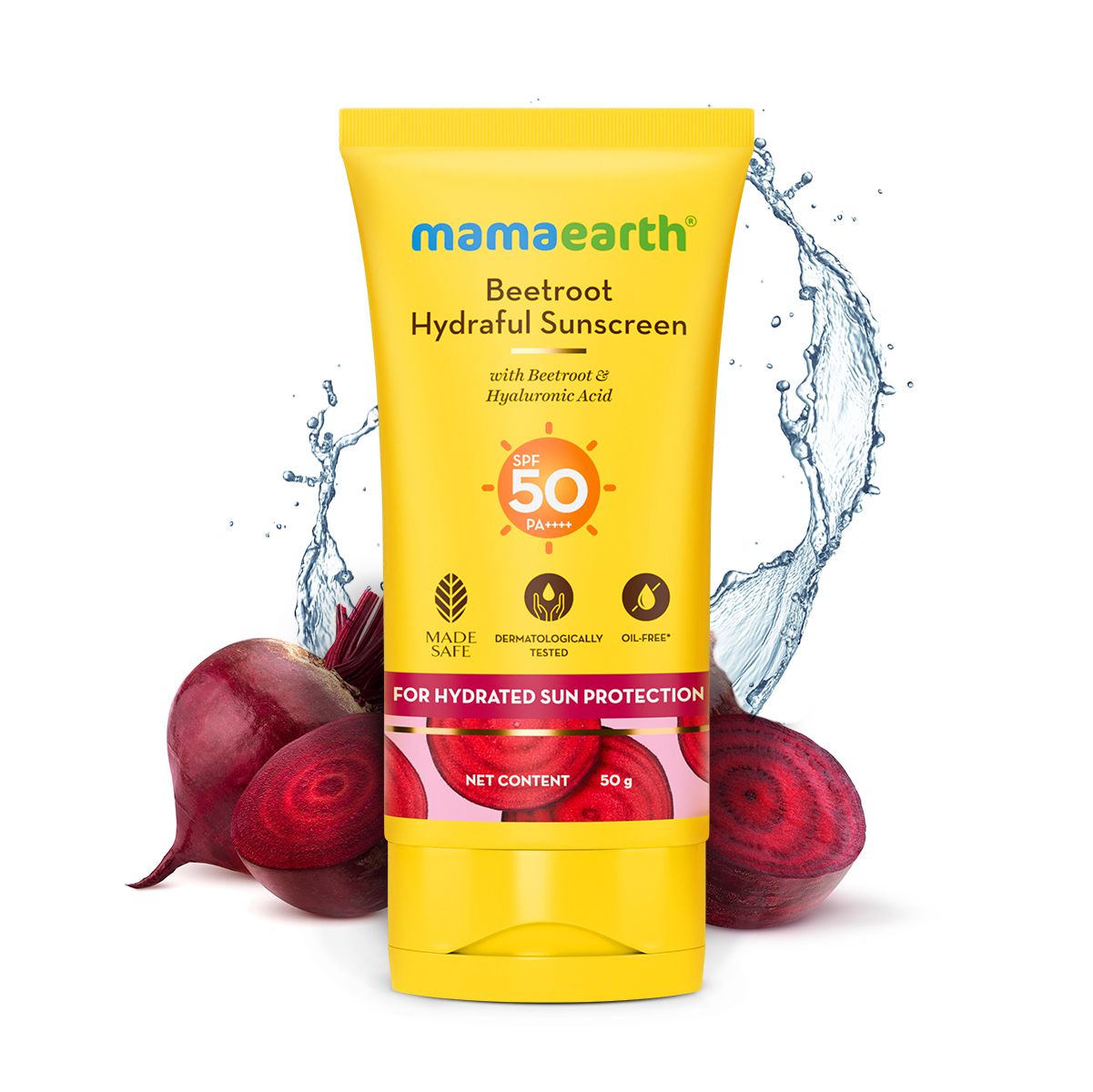
Beetroot Hydraful Sunscreen With Beetroot & Hyaluronic Acid - 50 g
The results on this page come from laboratory testing of a sample from batch AP4C087. See the complete ingredient list, current offers and reviews on the product page. Learn more about Hyaluronic Acid and Niacinamide. You can also explore the full product range or other products in this category.
View ProductFrequently Asked Questions
A: Yes. In this report, Lead, Cadmium and Arsenic were reported below the laboratory's stated detection limit of 0.25 mg/kg at Sigma Test & Research Centre, an NABL-accredited laboratory (Accreditation No. TC-5369).
A: For the tested batch, microbial counts were reported within the limits of the referenced standard and the specified pathogens were reported Absent. These results indicate the tested sample met the referenced microbiological limits; they do not establish overall product safety.
A: The measured pH in this report is 6.72.
A: The published ingredient list for this product contains no sulphates, parabens, silicones or mineral oil. This is based on the ingredient list, not on the laboratory report, which covers contaminants and microbiological quality.
A: No. The report covers chemical and microbiological parameters on a sample from the stated batch. Performance and cosmetic-benefit claims are made by the brand on the product page and are not part of this laboratory report.
A: "Not Detected" means a substance was below the laboratory's stated detection limit using the specified method. "Absent" means a specified microorganism was not detected in the tested quantity using the referenced method.
A: A ULR (Unique Lab Report) number is a one-of-a-kind identifier that NABL-accredited laboratories print on every test report, making it traceable. The ULR for this report is TC536924000003527F. The original report PDF linked on this page carries the laboratory letterhead and authorised signatory details.
A: No. NABL accredits laboratories, not products. This page reports the results of testing performed at Sigma Test & Research Centre, an NABL-accredited laboratory (Accreditation No. TC-5369) on a sample of this product. It does not represent a product certification by NABL.
A: The report covers batch AP4C087 (manufactured 03/2024). The laboratory report states the tested sample as 50 g x 6. Results refer only to the tested sample and the parameters listed.
References
- IS:6608:2004. Bureau of Indian Standards.
- IS:7679:1978. Bureau of Indian Standards.
- Indian Pharmacopoeia 2022. Indian Pharmacopoeia Commission.
- IS:14648:2011. Bureau of Indian Standards.
- Smijs TG, Pavel S. Nanotechnol Sci Appl. 2011;4:95-112.
- Sigma Test & Research Centre. Test reports 13023132/A, 13023132/B.


